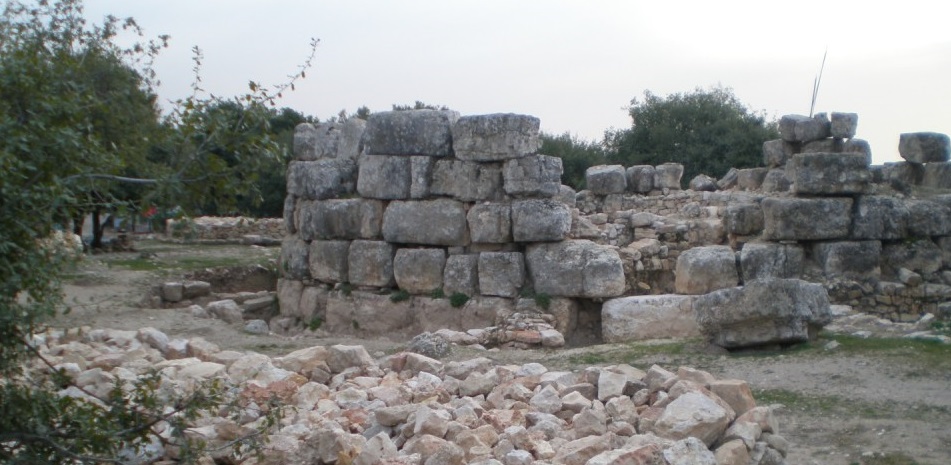
| Khirbet Al-Deir, |
| Khirbet Al-Deir, located about three kilometers from Al-Fuheis, is considered one of the rare sites whose architectural remains are still relatively intact. This is largely due to its distance from dense urban development and infrastructure services, which generally impact the preservation of archaeological sites. The area of the site is estimated to be around forty dunums, with the Department of Antiquities owning approximately 13 dunums of it. According to Saad Al-Hadidi, Director of the Salt Antiquities Office, who spoke about the Khirbet Al-Deir project, the true studies and archaeological excavation seasons at Khirbet Al-Deir began in 2002. The Salt Antiquities Office has conducted six archaeological excavation seasons, the most recent of which took place this year, with ongoing excavation efforts to uncover more about the site’s contents. Al-Hadidi highlighted that the most distinctive feature of Khirbet Al-Deir is the massive circular tower made of large white stones. This tower sits atop a high hill, overlooking all the surrounding plains and mountains. Archaeological evidence suggests that the tower was used both as a church and a station for carrier pigeons during the Ayyubid and Mamluk periods. This is supported by the artifacts found, which include a large collection of Ayyubid and Mamluk pottery, a bronze censer, various cross-shaped engravings, and some coins from those periods. Regarding other architectural features discovered at the site, Al-Hadidi noted that, in addition to the construction of the tower, numerous rooms, vaults, and elements of water systems, such as wells and reservoirs, were uncovered. A variety of wells were found, differing in size, shape, and construction methods—some carved into the rock, some built with stones, and others combining both excavation and masonry. The discovery of more than twenty wells so far indicates that the site relied on rainwater to meet its water needs. The number of wells exceeds the requirements of the civilian population, further suggesting the site's significant military role during the Ayyubid and Mamluk periods. Armies, along with their soldiers and many accompanying animals, would have needed extensive wells, large reservoirs, and numerous cisterns to meet their daily water needs. Additionally, a series of simple rock-carved water channels were found, most of which appear to be trenches for directing water from open courtyards into the reservoirs and wells. As for the vaults, three have been discovered, along with a collection of stone-built rooms located at various excavation sites. Among the most significant of these rooms are those found to the south and north of the circular tower, where a complex of interconnected rooms was unearthed. These rooms are linked by shared doorways, walls, and corridors, and their architectural condition indicates intensive and continuous use over successive historical periods. A rock-cut wine press was discovered, and it is believed that this press was used for crushing grapes. The archaeological finds included pottery artifacts, stone tools, and metal pieces. Among the most significant metallic artifacts discovered at the site were made of copper or bronze. However, the most notable find is a censer discovered in a grave constructed within the church of the tower. Additionally, a circular lamp holder with a decorative mesh and three protrusions, possibly used to hold it with a string or metal chain, was found; this artifact is also on display at the Salt Archaeological Museum. What's particularly intriguing about the metallic artifacts are the large quantities of iron slag scattered across the site, suggesting the presence of a factory or furnace for smelting and manufacturing weapons such as shields, swords, and spears. Unfortunately, these furnaces and workshops have not been discovered yet. Al-Hadidi added that several bronze coins have been unearthed in various excavation seasons at the site. Nearly all of these coins indicate that the site was occupied during the Ayyubid and Mamluk periods. One of the coins clearly bears the name of King Al-Salih Imad al-Din on one side, while another shows the name of Al-Mushrif Abu Al-Nasr Aynal. Regarding the stone tools, several carvings were discovered at the site, most of which feature religious-themed decorations. These carvings include various forms of crosses etched onto the surfaces of the stones. Some of these stones were found embedded within the interior walls of the church, while others were separate. Additionally, an inscription was found carved on a broken black basalt stone, with half of its lines missing. The inscription appears to tell of one of the Roman military commanders, suggesting it was brought from another location for a purpose that remains unclear. Al-Hadidi recommended that this site remain under study and excavation in the coming years. He suggested revitalizing ideas to transform it into a cultural and historical park, with the aim of showcasing important historical aspects of the Ayyubid-Mamluk period and the lifestyle experienced in this region during this significant era in Jordan's history. |